



Utah is blessed with a productive Uinta Basin that produces both oil and natural gas, and five oil refineries that serve the needs of our residents and those beyond our borders. As with any state or region, ours has unique benefits and challenges.
How much do you know about what makes Utah a unique place to do business? In our first issue of 2026, we have taken it upon ourselves to explore that uniqueness and discuss it from a variety of angles.
A Unique Product, Unique Geography
During the American Revolution, Benjamin Franklin was asked, “What have we got, a republic or a monarchy?” He famously responded, “A republic, if you can keep it.”
Regarding Utah, we have a basin poised for growth — if we can keep it.
The biggest contributing factor to the overall health of the oil and gas industry is crude oil prices. Crude oil is a globally traded commodity subject to a multitude of factors, including geopolitics, natural phenomena, consumer behavior and much more. We’ve written about “the butterfly effect” before, which means Utah is subject to events far beyond our control. And in terms of crude prices, the Energy Information Administration is predicting $55 per barrel in 2026, which is below optimal levels for maximizing production in the Uinta Basin.
Additionally, Utah has more federal lands than any other state but Nevada, as well as tribal jurisdictions, creating additional layers of regulatory complexity, risk and operating costs that other competing basins don’t face. When investors consider Utah, they compare it to other basins that don’t face these stacked costs. Investors don’t compare state tax vs. tribal tax; they look at the “all in” operating cost and risk. If Utah were to, for whatever reason, make wells more expensive, companies that operate across multiple basins would be forced to reconsider where they invest their dollars to maximize returns. If then production were to decline, the result would be less severance tax revenue, which, for one, would affect the state’s transportation budget.
To see this in action, one need only look to last year, when the legislature added a new production tax on all oil and gas to support local roads. The Division of Oil, Gas & Mining is also currently making new rules to increase its bonding costs. Continuing to stack costs on these wells makes them more likely to be shut in and will drop production and severance tax revenues to the state.
Regarding the product itself, Utah’s waxy crude requires significantly more expensive logistics to handle and transport (e.g., heated tanks, insulated transport, steam-equipped rail cars), adding around $11/barrel in transportation costs compared to $1-5/barrel in competing basins.
Compounding the issue is the reality of horizontal drilling. Horizontal wells exhibit very steep decline curves, peaking quickly with high production volumes, then often dropping 200% below initial production volumes within 30 months. Regular capital injections are needed to consistently drill new wells and maintain production, offsetting this decline curve. More on this ahead.
This is why we say we have a growth basin — if we can keep it. The success of the basin relies on a bevy of factors, and any tweak to those factors will have ripple effects throughout the basin, the economy and the State of Utah’s budget.
Speaking of Decline Curves …
In early November 2025, the U.S. Energy Information Administration published an analysis showing that horizontal wells experience rapid declines, requiring more drilling to sustain production.
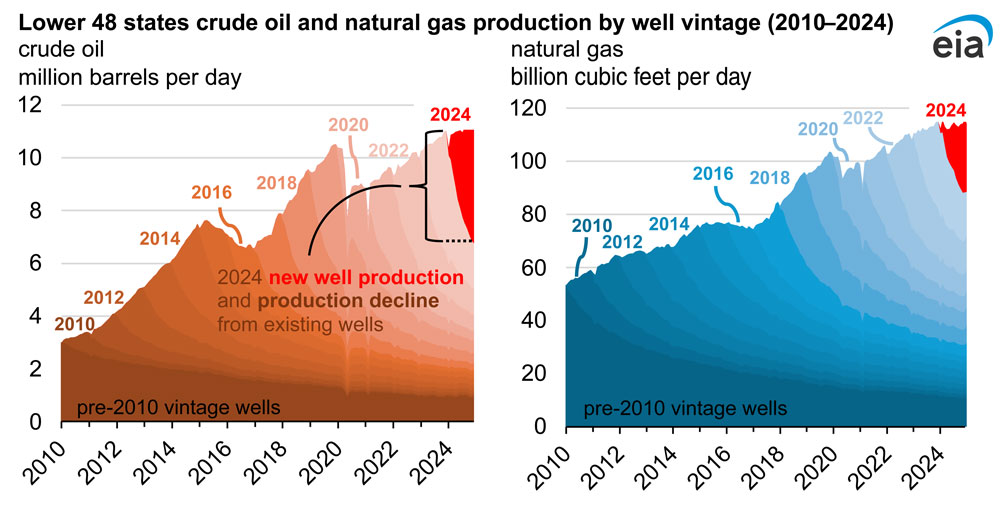
For those unfamiliar with this type of analysis, the graphs show that newer wells initially produce more, seen in the upward trend. But then follow the wave down, and you can see the angle go from something horizontal to looking more like it’s dropping off a cliff. The analysis expands upon this:
“Between 2010 and 2024, hydrocarbon production from new wells in the Lower 48 states (L48) generally offset and exceeded declining production from existing wells. Because production from oil and natural gas wells declines over time as reservoir pressure decreases, new wells are required to maintain the same production level. The increasing number of horizontal wells has contributed to this trend because horizontal wells exhibit higher decline rates than vertical wells.”
Why does this matter? It is crucial to ensure a stable and supportive regulatory and cost environment to sustain consistent investment in new drilling and maintain current production levels. The Uinta Basin has plenty of inventory to sustain new wells and maintain production, but if we don’t keep drilling new wells, which, it bears mentioning, comes with a massive price tag, production falls off sharply and very quickly.
That means state and municipal revenues are significantly at risk, including the severance tax. Why wouldn’t we continue to drill wells?
Consider a recent legislative proposal to add significant new taxes on crude and natural gas production, replacing the gas tax, a stable, longstanding revenue source, with a new, unstable revenue source pegged to highly volatile commodity prices, and that would land squarely on the backs of the oil and gas industry, rather than road users. More on this ahead as well.
Increasing the cost of drilling new wells in Utah makes the basin less competitive for investment dollars than other basins. We can’t move the oil and gas, but the dollars it takes to unlock it move quickly. This isn’t speculation; we have seen companies and investment dollars move into and out of the basin for decades. We have finally “cracked the code” of the basin; we have doubled production in a few short years and are proud to say that we are one of only two growing basins in the U.S.
It seems to us a rash policy decision to shift taxes from a broad group of users to a single industry, risking the backbone of the basin economy. Combine this with the steep decline curves associated with horizontal drilling, and the loss of production and risk to transportation (and severance) funding under this new proposal, and it becomes a double whammy. Not to mention the prospect of actually selling fewer products to other states. But why?
What a New Tax Would Do To Exports
Utah’s refineries produce more products than the residents of Utah need. Once local demand is met, our products are sold in other states, such as Idaho and Nevada. In the 2026 session, our legislature considered an export tax on fuel sold to those states with the stated goal of raising revenue to offset a proposed decrease in the gasoline tax. No other state does this because it violates the Commerce Clause of the United States Constitution. Putting aside the (il)legality of this proposal for a moment, here’s why this proposal is unlikely to raise the desired revenue. It’s basic free market economics.
If fuel produced in Utah becomes more expensive, then Idaho, Nevada and other states will find other lower-cost sellers (like Montana, Colorado, Wyoming and Canada), which means less fuel sold by Utah refiners and ultimately less money for Utah. If Utah cannot cost-effectively export excess gasoline, it will have to reduce production, making significantly less jet and diesel fuel, tightening fuel supply in Utah and the region, and driving up prices at the pump and across the economy. The ripple effects would be real and extend further than many decision-makers have likely considered.
Never mind that by attempting to place an export tax on fuel, the state of Utah risks needless, costly and ultimately unsuccessful lawsuits from other states. The Commerce Clause of the U.S. Constitution limits state authority; the most fundamental of these limits is the prohibition on state taxes that discriminate against interstate commerce. Later proposals looked at a new refinery production tax, which still has legal issues following a long line of judicial precedent that says a state may not do indirectly what it may not do directly. Washington State proposed a nearly identical export tax in 2022 to compensate for the environmental externalities of fuel production exported to other states. Pressure from Idaho, Oregon and Alaska, and the threat of legal action, led Washington to withdraw the proposal.
A California Case Study
California has aggressively sought to move on from fossil fuels by instituting draconian regulations, setting ambitious timelines to transition its electric grid entirely to renewable resources while phasing out sales of internal combustion engines in its transportation sector, and filing absurd lawsuits against oil and gas companies. None of this has benefited the people of California, who have faced increasingly expensive energy costs and reduced electricity reliability.
So, what would happen if Utah followed in California’s footsteps and adopted additional taxes on our downstream sector? Increasing the cost of finished product exports risks the stability of Utah’s refineries and could ultimately increase costs for Utahns. All five of Utah’s refineries are considered “small refineries,” where economies of scale are a disadvantage, with higher costs spread over a smaller volume of production, challenging comparative costs in Utah. Utah’s refineries are continuing to maintain and expand capacity and run at near maximum capacity, as neighboring states reduce capacity. A tax on Utah refined product sales makes Utah refineries less competitive, risking their ability to continue to run at max capacity and expand. If Utah production declines, prices will go up.
Fuel refining starts with the manufacture of gasoline, and from that, jet fuel and diesel are made. If we export less gasoline because of an unfavorable price, we will produce less gasoline. Less gasoline means less diesel and jet fuel, raising the costs for Hill Air Force Base, Delta Airlines and diesel users (homebuilders, agriculture, mining, etc.) as volumes decline.
Refineries require major capital investments into yearly maintenance to operate efficiently and safely. Continued future profitability is critical in supporting those regular investment decisions. Refineries in California shut down because the state’s regulatory environment prevented them from justifying the necessary capital investments in ongoing operations.
Many people move to Utah from California, and many of them want to leave behind the policies that made California less desirable to live in. It would be strange, in the name of raising money from exports, to adopt a policy that would do exactly the opposite. And what about all those people who move to Utah?
Cost of Housing vs. Gas Prices
A headline from the Salt Lake Tribune last summer reads: “Many Utahns ‘stuck’ with hourlong commutes amid housing crisis.” Interesting. Diving in a little deeper, here’s what the article says:
“‘In today’s housing market, it’s clear some households commute long distances either out of necessity or preference,’ said economist Jim Wood.
Utah is now tied with Idaho and Rhode Island for the seventh-most-expensive market in the nation, with a median listing price of $599,450, according to the Federal Reserve Bank of St. Louis. That’s behind Montana and just ahead of Colorado.”
The article also includes a multitude of anecdotes from people who have chosen affordable housing far from their workplaces and about the length of their commutes. One woman shares that her “drive into Salt Lake City is about 50 minutes. With traffic, it can stretch to as long as two and a half hours.” Oddly, gas prices are never mentioned in this article.
Another one from less than a week later reads: “Why these Utahns are OK with their daily commutes.”
Again, no mention of gas prices in this article. A lot goes into gas prices: the price of globally traded crude oil, Utah’s unique geographic and topographic position, the relatively small size of Utah’s refineries compared to those on the Gulf Coast — but one thing we’ve yet to touch on is simple supply and demand.
If housing in Utah is expensive, pushing people further away from their jobs, it stands to reason that Utah motorists will need more gasoline. And in fact, Utah’s fuel demand has increased 5.2% since 2016, while the national average fuel demand has dropped 5.7% over the same period.
Utah is a popular place to live, with thriving economic growth, and while growth is generally preferable to contraction, it also has its own challenges. Lots of people want to enjoy Utah for its abundant benefits and high quality of life. Where and how you fit all those people isn’t easily solved, and that central tension leads to ripple effects that contribute to issues like gas prices.
And this problem isn’t going away. A recent article in the St. George News sports the headline: “Utah listed among two-thirds of states where home-buying is increasingly unattainable.” The article goes on to state:
“In October, Redfin reported that home prices in Utah were up 4.8% compared to last year, selling for a median price of $578,500. Just five years ago, the average homebuyer here could purchase the average home on an $80,000 income, according to a 2020 report aired by KUTV-News.
But a Bankrate.com study in 2024 found that a Utah homebuyer needed a $134,000 income to purchase the average home at a price of $525,000. Although national officials are loath to use exactly those terms, Utah residents are by no means alone in facing the U.S. affordability crisis.”
Utah is an incredible place to live and do business, and we at the Utah Petroleum Association are fortunate to represent this industry. Our job is to work with stakeholders at all levels and of all types to ensure a productive, prosperous, and thriving oil and gas industry that benefits us all. We educate, we advocate, we collaborate. Our ultimate goal is to equip decision-makers with the information they need to make decisions. That’s why we thought it prudent to help you understand the unique challenges and opportunities ahead.
The Utah oil and gas industry is a growth industry — if we can keep it.